

Overview of Global Industrial Equipment Manufacturing Dynamics
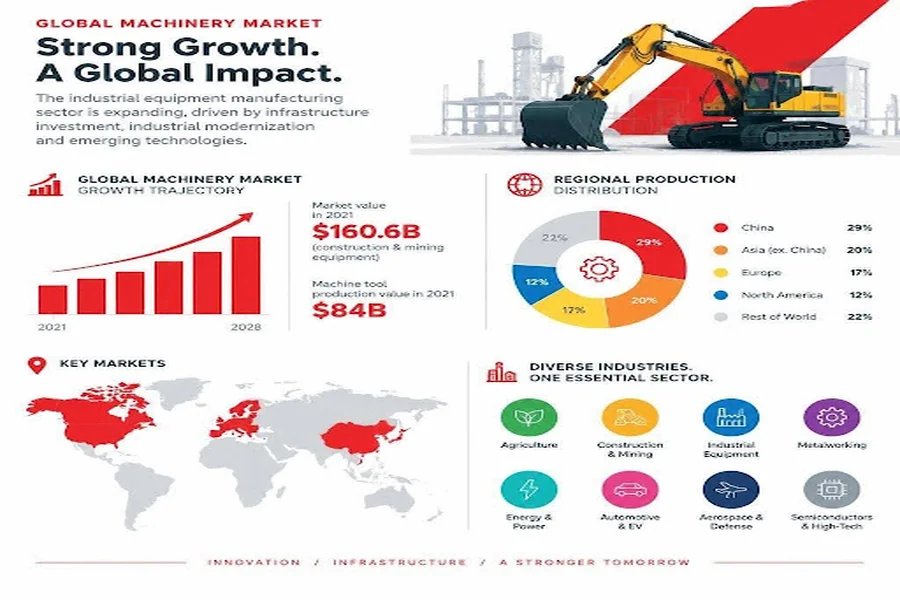
The industrial equipment manufacturing sector forms the backbone of global progress, powering industries from energy and infrastructure to advanced technology. It’s a massive and dynamic industry, with the construction and mining equipment market alone valued at over $160 billion in 2021. This vital sector continuously innovates to meet the complex demands of a rapidly evolving world.
In this comprehensive guide, we will explore the intricate landscape of industrial equipment manufacturing. We will delve into its current market size and growth trajectory, identify the diverse industries it serves, and uncover how cutting-edge technologies like automation, 3D printing, and artificial intelligence are reshaping its future. We will also examine the key challenges that the industry faces and provide an outlook for its strategic direction over the next few years. We will see how specialized solutions, such as custom-engineered vibratory equipment, are essential for efficient material handling and processing across various industrial applications.
The global industrial equipment manufacturing sector is a powerhouse, driving economic activity and technological advancement across continents. As of October 2026, the market continues its robust growth trajectory, propelled by increasing demand from diverse sectors. The global construction and mining equipment industry, a significant segment within this sector, was valued at nearly $160.6 billion in 2021 and is projected to rise steadily through 2028. Simultaneously, the production value of machine tools reached almost $84 billion in 2021, underscoring the foundational role of precision manufacturing in the broader industrial landscape.
Geographically, East Asia, North America, and Western Europe remain the primary markets for industrial equipment, characterized by high levels of urbanization and significant infrastructure investment. China stands out as a dominant force, holding a substantial 29% market share in global machine tool production in 2021, alongside other key producers like Germany and Japan. This sector, categorized under NAICS 333, encompasses a wide array of machinery, from agricultural and construction equipment to specialized industrial, commercial service, HVAC, metalworking, engine and power transmission, and general-purpose machinery. The demand for these diverse machines fuels substantial capital expenditure and continuous innovation.
Economic Trajectory, Capital Investment, and Regional Demand
The economic trajectory of industrial equipment manufacturing is closely tied to global infrastructure development and industrial modernization. The construction and mining equipment segments, for instance, are expected to see sustained growth through 2028. The sheer scale of operations is evident in the global off-highway equipment market, which recorded a volume of 45.62 million units. Large-scale public and private infrastructure projects, such as the Belt and Road Initiative, continue to be significant drivers of demand for heavy machinery.
Pricing dynamics within the sector reflect broader economic trends. The Producer Price Index (PPI) for U.S. machinery manufacturing stood at 198.989 in July 2026, indicating a 0.4% increase month-over-month. These shifts are crucial for manufacturers in managing costs and setting competitive prices. Beyond traditional sectors, emerging industries are rapidly becoming major customers. The burgeoning EV and battery production, extensive automotive retooling for electric vehicle manufacturing, and expansion in aerospace and defense sectors are creating new demands for specialized equipment. Furthermore, the construction of new semiconductor facilities and ongoing plant modernization efforts across various industries necessitate continuous investment in advanced machinery.
Workforce Evolution in Industrial Equipment Manufacturing
The industrial equipment manufacturing workforce is experiencing its own evolution, marked by both stability and the need for new skills. In July 2026, employment in U.S. machinery manufacturing reached 1,091,200, with a notably low unemployment rate of 2.1% for workers previously employed in the sector. Average hourly earnings for all employees in this segment were $39.26 in July 2026, reflecting competitive compensation. Specialized roles command higher wages, with mechanical engineers in machinery manufacturing earning a median annual wage of $98,620 in 2025, and machinists earning $59,590.
Productivity within the sector is also on an upward trend, with labor productivity (output per hour) in U.S. machinery manufacturing growing by 2.2% in 2025, following several years of decline. The industry is characterized by a significant number of establishments, totaling 35,154 in the fourth quarter of 2025. While safety remains a paramount concern, the sector has seen a decline in fatalities, with 23 in 2023 and 21 in 2024. The total recordable injury and illness case rate was 2.3 per 100 full-time workers in 2024, indicating a strong focus on workplace safety. The increasing mechanization and automation are reshaping labor demands, necessitating continuous technical upskilling, multi-axis training, and specialized fabrication expertise to meet the evolving requirements of modern manufacturing processes.
Advanced Technologies and Engineering Strategies Driving Production
The industrial equipment manufacturing landscape is being fundamentally transformed by advanced technologies and sophisticated engineering strategies. Automation systems are no longer just an advantage but a necessity, enhancing efficiency and precision across production lines. Central to this transformation is robust power distribution, which is not merely a utility but a strategic differentiator. Designing scalable power systems and tailoring solutions to specific industry requirements are critical for maximizing operational uptime and supporting growth. Many manufacturers are also exploring retrofit strategies to upgrade outdated electrical infrastructure, while compact equipment designs help optimize valuable floor space. The integration of precision sensors and industrial IoT (Internet of Things) allows for real-time performance tuning and predictive maintenance, minimizing downtime and boosting productivity.
Technological Integration: Automation, Additive Manufacturing, and AI
Technological advancements are rapidly accelerating the capabilities of industrial equipment manufacturing. Additive manufacturing, commonly known as 3D printing, is emerging as a transformative technology. It enables layer-by-layer production, facilitating rapid prototyping and efficient low-volume manufacturing, positioning it as a catalyst for the next industrial revolution. Alongside this, advanced machining techniques, including multi-axis (5-axis) machining, are crucial for reducing setups and achieving superior positional accuracy, while wire EDM and automated metal forming processes streamline complex part fabrication.
Artificial intelligence (AI) is also playing an increasing role, optimizing production processes for real-time performance and efficiency. These sophisticated manufacturing processes are often powered by highly specialized components. For instance, the precision and control required for advanced robotics and automated systems often rely on high-precision electric motors. These motors are essential for precise motion control, contributing to significant energy efficiency gains and cycle time reductions in complex machinery.
Custom Engineering and Precision Components in Industrial Equipment Manufacturing
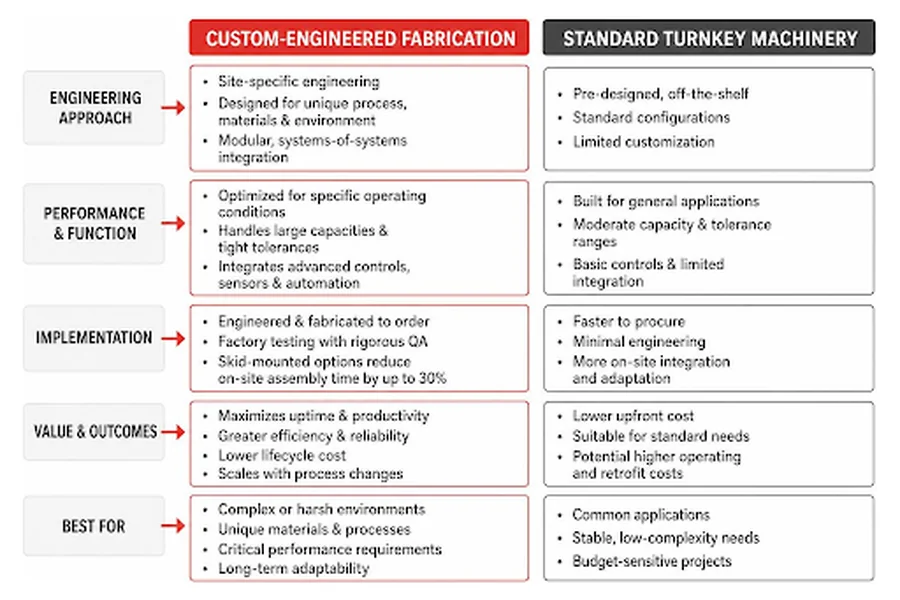
In an industry where unique operational challenges are the norm, custom engineering has become a cornerstone of effective industrial equipment manufacturing. This approach involves site-specific engineering, where equipment is meticulously designed to adapt to a plant’s particular environment and material characteristics. For sectors dealing with bulk material handling, this includes a range of specialized equipment such as apron feeders, belt feeders, conveyors, debarkers, rotary fibre processors, and dynamic roll screens.
A modular, “systems-of-systems” approach is gaining traction, combining best-in-class mechanical reliability with modern digital controls. This strategy offers greater flexibility and adaptability compared to generic turnkey solutions. For example, custom-engineered vibratory equipment is vital for efficiently processing and conveying materials, ensuring optimal flow and separation in demanding applications. The manufacturing of these components often requires working with extremely tight tolerances and handling large capacities, with some facilities capable of machining parts with a 110-ton maximum table load or components weighing up to 300 tons. This level of precision and scale underscores the commitment to delivering robust and reliable solutions.
Modular Skid Systems and Quality Compliance Frameworks
The trend towards modularity is also evident in the increasing adoption of skid-mounted systems. These factory-assembled and tested units simplify on-site installation, often reducing assembly time by up to 30%. This approach not only improves quality control but also offers greater predictability in project timelines.
Quality and compliance are non-negotiable in industrial equipment manufacturing, especially for components operating under high stress or in regulated environments. Manufacturers adhere to a stringent array of certifications and standards. For pressure vessels, this includes ASME U-stamp, ASME Section VIII Div. 1, and ASME B31.3. Broader quality management systems like ISO 9001 are standard, while specialized sectors demand AS9100D for aerospace, CMMC Level 2, and ITAR compliance for defense-related projects. Welding processes are rigorously controlled, often meeting standards like AWS D1.1. Comprehensive quality assurance involves non-destructive examination (NDE), detailed inspection and test plans (ITPs), weld maps, and certified pressure test records, all backed by precision inspection and rigorous factory testing.
Strategic Outlook and Industry Sustainability Through 2030
Looking ahead to 2030, the industrial equipment manufacturing sector faces a complex but opportunity-rich landscape. Key challenges include navigating persistent supply chain issues, addressing labor shortages, and ensuring stringent regulatory compliance. Building supply chain resilience is paramount, involving strategic procurement practices such as robust RFQ processes, thorough vendor audits, expediting critical components, and meticulous material control. Effective lead-time management is crucial for meeting customer expectations in an unpredictable global market.
The trend towards single-partner integration, where a single entity handles engineering, manufacturing, and quality assurance, is expected to grow. This model reduces handoffs, shortens lead times, and improves overall quality control. Managing raw material inflation will remain a significant concern, requiring agile pricing strategies and strong supplier relationships.
Sustainability is also moving to the forefront of industry priorities. Manufacturers are increasingly focused on environmental compliance, developing more energy-efficient systems, and exploring cleanroom engineering for sensitive applications. Facility expansions, like the $200 million factory expansion announced by IEM in Texas, are indicative of the industry’s commitment to growth and job creation, with projections of 3,000 new positions. The market forecast for the next 3-5 years points to continued investment in capital equipment, driven by ongoing industrial modernization and technological integration. Operational agility will be key for manufacturers to adapt to changing market demands and maintain long-term productivity and competitiveness.
