

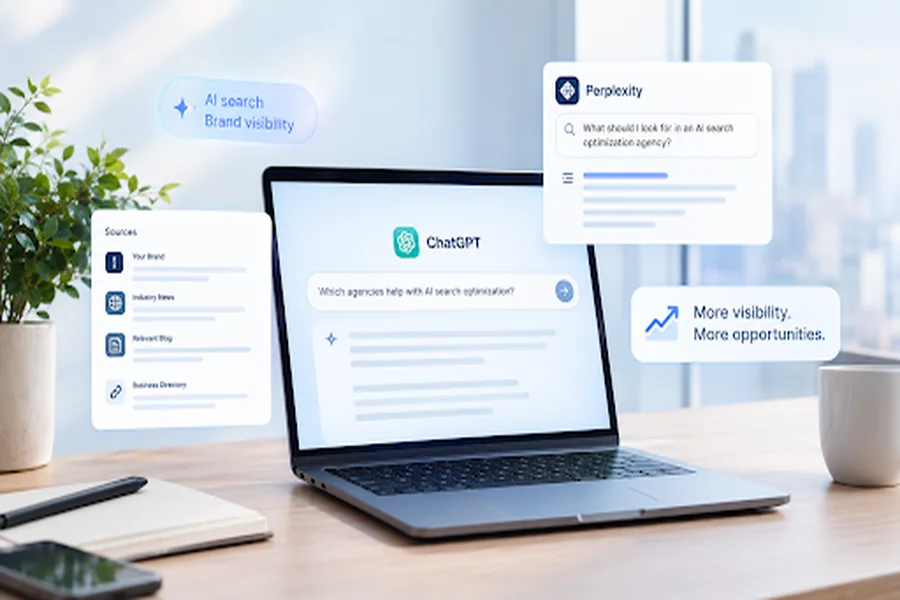
AI search is changing how people discover brands, compare solutions, and research purchases. When potential customers ask ChatGPT or Perplexity for recommendations, some brands appear in cited sources while others remain absent.
A 2025 Pew Research Center study found that users clicked traditional search results in just 8% of visits involving Google’s AI summaries. Without an AI summary, that figure was 15%. Although this study examined Google rather than ChatGPT or Perplexity, it highlights why visibility within AI-generated answers deserves attention.
For marketing teams, the challenge is becoming easier to overlook. A brand can maintain strong organic rankings yet remain absent from AI-generated answers for important category queries.
The solution starts with identifying what prevents AI systems from finding, understanding, and referencing a brand. Here are five signs to investigate, along with practical tests for each.
1. Your Brand Never Appears in Answers to Category Queries
When someone asks an AI assistant to recommend solutions within a category, does your brand appear among the options? If established competitors appear repeatedly while your brand remains absent, your content and external presence may not provide enough relevant evidence.
AI-generated answers vary by query, available sources, search settings, and model behavior. One missing mention does not prove a visibility problem. However, repeated absence across relevant questions can reveal a pattern worth investigating.
Why It Matters
Category queries often reflect active research. People may ask for software recommendations, agency shortlists, or comparisons between service providers.
If your brand does not appear, potential customers may never encounter it during this research stage. Traditional rankings alone cannot confirm whether your brand appears in these answers.
How to Fix It
Build a list of 10–20 realistic prompts related to your category, services, audience, and buying criteria. Include questions such as:
- Which agencies help startups improve AI search visibility?
- What should a business look for in an AI search optimization agency?
- Which providers help brands improve their visibility in generative search?
- How can a marketing team measure its presence in AI-generated answers?
Test these prompts in ChatGPT and Perplexity. Record brand mentions, citations, cited domains, and how each answer describes your company.
Repeat the tests periodically using consistent prompts and settings. Separate answers with web search enabled from those without it, where applicable.
Then compare your findings with relevant competitors. Look for differences in service-page detail, expert commentary, independent coverage, and the clarity of information available about each business.
Quick self-test: Run 10 category-related prompts in each platform. How often does your brand appear, and which sources support those mentions?
2. Your Brand’s Entity Information Is Thin or Inconsistent
AI systems need reliable information to understand what an organisation does, whom it serves, and how its products differ from other offerings. A website that describes a business using vague claims may leave important questions unanswered.
This problem becomes more significant when different pages describe the company inconsistently. Your homepage might position the business as a digital marketing agency, while service pages provide little detail about its specialisms or ideal customers.
Why It Matters
A brand is more than its name and website. Relevant information includes its official identity, services, locations, leadership, expertise, and relationships with other organisations.
Structured data can help search engines interpret these details. Google recommends adding relevant organisation properties to help clarify business information. However, structured data does not guarantee that a brand will appear in AI answers.
How to Fix It
Start by reviewing your homepage, About page, service pages, and contact information. Ensure they communicate a consistent business identity and explain your actual capabilities.
Include specific details where appropriate:
- Brand identity: Use the correct company name, official website, and logo.
- Service information: Explain what each service includes and which business problems it addresses.
- Expertise: Publish verifiable case studies, relevant experience, and named authors where appropriate.
- Business details: Keep locations, contact information, and company descriptions accurate.
- Structured data: Implement relevant Organisation or more specific schema markup when appropriate.
For example, an AI search optimization agency should explain how its services address discoverability, content accessibility, source credibility, and measurement. A generic statement about helping brands grow online provides less useful detail.
Make important information easy to find in readable website content. Structured data should support accurate visible information rather than replace it.
Quick self-test: Ask a colleague unfamiliar with your business to identify your services, target audience, and key differentiators using only your website. If the answers remain vague, your brand information needs clarification.
3. Third-Party Profiles Contain Outdated or Conflicting Information
Your website is not the only place where potential customers discover your brand. Industry directories, professional profiles, partner websites, news coverage, and review platforms can also provide useful context.
Problems arise when these sources contain old service descriptions, discontinued products, incorrect contact details, or inconsistent company names. A neglected profile may also omit important developments that explain your current expertise.
Why It Matters
AI-generated answers can draw on information from multiple sources, depending on the platform and query. For search-enabled answers, accessible third-party pages may provide additional context about a company.
Consistent information helps reduce confusion, but consistency alone does not guarantee visibility. Source relevance, accuracy, accessibility, and the specific question still matter.
How to Fix It
Audit the external profiles most relevant to your industry and audience. Prioritise sources with genuine relevance rather than creating profiles everywhere.
Review the following areas:
- Business directories: Correct company names, descriptions, URLs, and contact details.
- Professional profiles: Update service offerings, leadership information, and areas of expertise.
- Partner websites: Confirm that current partnerships and service descriptions remain accurate.
- Industry publications: Check whether company references link to current pages and reflect verified information.
- Reviews and case studies: Ensure published material is authentic, current, and properly attributed.
Where possible, prioritise substantive coverage over simple mentions. A detailed case study explaining a problem, the work performed, and the documented results provides more context than an unsubstantiated promotional claim.
Avoid manufacturing mentions or publishing repetitive descriptions solely to influence AI responses. Build external visibility through useful contributions, genuine partnerships, and credible industry participation.
Quick self-test: Search your brand name alongside terms such as “services,” “review,” “case study,” and your main product category. Check whether the most relevant results accurately describe your current business.
4. Technical Settings Prevent AI Search Crawlers From Accessing Your Website
Strong content cannot contribute to search visibility if relevant pages are inaccessible to the systems expected to retrieve them. Technical restrictions can therefore undermine an otherwise well-developed content strategy.
OpenAI documents separate crawler controls for search and model training. Its OAI-SearchBot is used to discover websites for ChatGPT search, while GPTBot relates to potential model-training use. These controls serve different purposes.
Why It Matters
A website may unintentionally block relevant crawlers through robots.txt rules, server restrictions, security settings, or access requirements. Individual pages may also contain noindex directives or depend on content that automated systems cannot readily retrieve.
These issues require careful diagnosis. Allowing a crawler does not guarantee indexing, citation, or inclusion in an answer.
How to Fix It
Ask your technical SEO or development team to review these checks:
Check robots.txt. Review the rules for the relevant user agents. Confirm that important public pages are not unintentionally disallowed.
Verify crawler access. OpenAI publishes documentation for OAI-SearchBot and its published IP ranges. Use the official guidance to distinguish legitimate crawler requests from other traffic.
Review server responses. Check whether important pages return successful HTTP responses. Investigate authentication requirements, security challenges, and persistent server errors.
Inspect page directives. Review noindex tags and relevant HTTP headers. Confirm that public pages intended for discovery are not accidentally excluded.
Test important content. Make sure key service descriptions and supporting information are available in accessible page content. Check whether essential text depends entirely on scripts or interactions that automated retrieval may not process.
Perplexity also documents its crawler and publisher-access controls. Review the platform’s current technical guidance before changing any rules.
Keep crawler permissions intentional. Separate decisions about search visibility from decisions about allowing content to be used for model training.
Quick self-test: Review your robots.txt file, test key service-page URLs, and inspect server logs for crawler activity. Investigate access errors before assuming that content quality is the problem.
5. Your Content Targets Keywords but Does Not Answer Real Questions
A website can publish dozens of keyword-focused articles without clearly explaining the business’s expertise. Repeated phrases, broad claims, and shallow explanations may satisfy a content calendar while leaving readers without useful answers.
AI search optimisation requires more than inserting target keywords into headings. Content needs to address specific questions with clear explanations, relevant evidence, and enough context to support the claims.
Why It Matters
People rarely describe every problem using the exact wording found in a keyword research tool. They may ask about costs, implementation, risks, suitability, or how two approaches differ.
Content that answers these questions directly can serve users across multiple discovery paths. However, no particular writing format guarantees that AI platforms will cite a page.
How to Fix It
Begin with the questions your audience asks before choosing a provider or making a purchase. Use sales conversations, customer interviews, search queries, support records, and relevant industry discussions to identify genuine information needs.
Then improve your content in five ways.
Answer the main question early. Introduce the issue and provide a direct response before expanding into supporting details.
Add meaningful specifics. Explain processes, limitations, requirements, and practical considerations. Replace unsupported superlatives with evidence.
Demonstrate experience. Publish original research, documented case studies, expert commentary, and examples that reflect real work. Explain the methodology behind performance claims.
Use descriptive headings. Organise information around the questions readers need answered. Use concise paragraphs, meaningful subheadings, and lists where they improve comprehension.
Keep information current. Review statistics, product details, service descriptions, and references. Update outdated information rather than adding new articles that repeat existing material.
For example, an article about AI search optimisation should explain how to measure brand mentions, assess citation patterns, investigate crawler access, and interpret changes over time. It should also acknowledge that AI answers vary and that citation tracking is not a direct measure of revenue.
An effective content strategy connects related pages into a useful resource. A central service page can explain the offering, while supporting articles cover measurement, technical implementation, and content development.
Quick self-test: Select five important articles. Can each one answer its headline question within the opening paragraphs, provide useful evidence, and offer practical next steps? If not, improve the existing content before expanding the keyword list.
Turning These Checks Into an AI Search Optimisation Plan
These five signs often overlap. A crawler issue can limit access to useful content, while incomplete business information can make your expertise harder to establish. Outdated third-party profiles can add further inconsistencies.
Start with a baseline rather than changing everything at once. Record your brand’s visibility across a consistent set of category prompts, identify cited sources, and document technical or content issues. Prioritise fixes according to their business relevance and the effort required.
Review results regularly, but interpret short-term changes carefully. AI-generated answers can change between sessions, and there is no universal citation rate that guarantees commercial success. Track supporting indicators, including relevant brand mentions, referral traffic where measurable, qualified enquiries, and assisted conversions.
For teams that need a structured approach, an AI search optimization agency can help connect technical checks, content improvements, brand information, and visibility measurement. Businesses looking to strengthen their presence in AI-generated answers can learn more here about AI search optimization services.
GTMLab supports businesses with digital marketing strategy and optimisation. An example from the dental sector would be a dental clinic aiming to attract more patients searching for treatments such as dental implants, teeth whitening, or orthodontics. Through traditional SEO, the clinic can improve its website rankings and attract organic traffic. However, with the growing adoption of AI-powered search, the clinic also needs accurate and consistent information across its website, professional profiles, online publications, and other relevant platforms so AI systems can better understand and recommend its services.
This is where AI search optimization and Generative Engine Optimization (GEO) can complement traditional SEO, helping dental clinics build visibility throughout the patient decision-making journey. Explore drgagency to learn how specialised digital marketing strategies for dental clinics can support stronger search visibility and long-term business growth.
The practical starting point is straightforward: identify where your brand is missing, establish why, and fix the evidence or access gaps that can be verified. Build from there, measuring progress against consistent prompts and meaningful business outcomes rather than isolated AI mentions.
